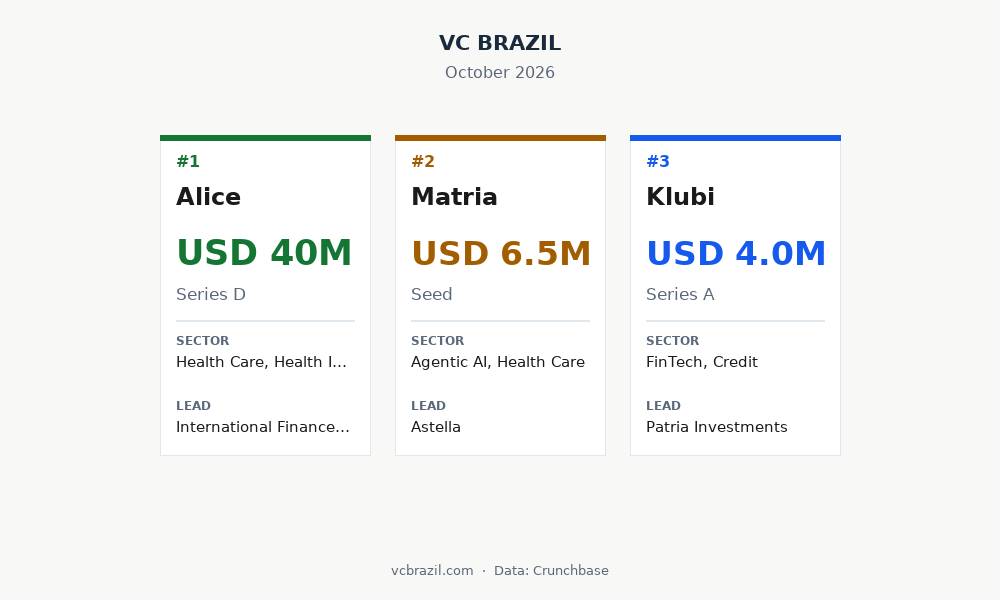
October 2026 was a one-headliner month in Brazilian venture capital. Remove Alice‘s USD 40M Series D from the ledger, and total disclosed deal flow barely clears USD 14M — a quiet month by the standards of a year that opened with infrastructure giants and AI stampedes. What it lacked in volume it made up in signal: the round was led by the International Finance Corporation, the World Bank Group’s private-sector arm, marking the moment Brazil’s corporate health insurance market graduated from domestic-VC darling to something multilateral development banks put on their balance sheets. That tends to happen when a company posts R$1.2 billion in annualized recurring revenue, up roughly 70% year on year.
Beneath the top line, October’s field was compact but coherent. Artificial intelligence appeared in almost every pitch across every sector — health data infrastructure (Matria), fashion photography (Futuriza), WhatsApp marketing (Revi), social commerce automation (Gaio), B2B sales coaching (Imersa) — which at this point is less a trend than a background condition. What is changing is the specificity: founders have moved past “AI-powered” as a label and into “AI does one narrow thing relentlessly.” Fashion photography and protein manufacturing are genuinely different problems. The fact that Brazilian founders are building vertical AI products for both in the same month suggests the ecosystem has found its footing past the generalist-chatbot phase.
The month’s most idiosyncratic deal came from BioLinker, an eight-year-old synthetic biology company that raised BRL 8.4M to build an automated protein lab in Manaus, backed in part by Fabricio Bloisi — the CEO of iFood. That combination of deep-tech biology, Amazonian geography, and consumer-internet money is probably unique in Brazilian startup history, and the investors clearly want to keep it that way.
Deep Dive: Top 5 Most Relevant Deals
1) Alice — Series D, USD 40,000,000
Founded in 2019 by André Florence, Guilherme Azevedo, and Matheus Moraes, Alice operates Brazil’s most technologically ambitious employer-sponsored health plan. It is not, to be precise, a traditional health insurer; it is a care management platform that happens to hold an insurance license. The difference matters commercially: where legacy insurers profit by limiting care, Alice profits by preventing costly interventions — using AI to coordinate primary care, diagnostics, and specialists before the expensive hospitalization. The model appears to be working. At the time of the round, the company reported R$1.2 billion in annualized recurring revenue, up roughly 70% year on year, with a target of R$2 billion by 2027.
The Series D was led by the IFC with participation from Germany’s DEG (the development finance arm of KfW), Finland’s Finnfund, Kaszek, ThornTree Capital Partners, and Canary. Notably absent: SoftBank, which led Alice’s 2022 Series C. The shift from pure growth equity to development finance capital is deliberate and revealing — IFC bets on category winners in markets where private healthcare access is a development-finance priority, and Brazil’s combination of a 220-million-person population, a strained public health system, and a nascent corporate benefits sector checks every box. Alice plans to roll out its AI health assistant to its full membership in November 2026; member adoption data will be the next thing worth watching.
Previous rounds
2022 / Series C / USD 127,000,000 — lead: SoftBank
2021 / Series B / USD 33,300,000 — lead: ThornTree Capital Partners
2) Matria | Data For Better Care — Seed, USD 6,500,000
Matria was founded in 2023 by João Vitor Innecco with a thesis that hospitals have never lacked data — they have lacked connectivity. The Belo Horizonte company builds what it calls a Healthcare Data Fabric: a middleware layer that connects legacy hospital management, billing, and care systems, then deploys AI agents to surface clinical context wherever it is needed in the patient journey. With more than 100 clients including Rede D’Or, Rede Américas, and Hospital Israelita Albert Einstein, Matria has quietly become infrastructure for a meaningful slice of Brazil’s private health market in just three years.
The USD 6.5M seed was led by Astella with participation from Afya — the Brazilian medical education and health services company that also co-led Matria’s earlier pre-seed — along with Floating Point, Fluent Ventures, Paulo Chapchap, and Scale-Up Ventures. Afya’s repeat participation is worth noting: a healthcare company that sells education and services to Brazil’s medical community is writing checks into infrastructure that makes those same hospitals run better. The round will fund expansion into Mexico and a scale-up of Matria’s product, engineering, and sales teams.
Previous rounds
2024 / Pre-Seed / BRL 8,000,000 — lead: Afya
3) Klubi — Series A, USD 4,016,871
Consórcio — the distinctly Brazilian installment-savings-club model for buying cars, real estate, and appliances — is old enough to feel like furniture. Klubi is betting it has never been properly digitized. Founded in 2021 by Eduardo Rocha, the São Paulo fintech sells consortium plans online and uses WhatsApp, SMS, and RCS as its primary customer channel — a move it says produced a fourfold increase in lead conversions and a 25% rise in purchase completion rates. That is the pitch: a structurally familiar product delivered through a modern distribution stack.
The October check came from Patria Investments’ Fund III, writing more than BRL 20M as the second extension of Klubi’s Series A. The original round opened in late 2024 at R$45M with L4 Venture Builder (backed by B3, the Brazilian stock exchange operator) and Vivo Ventures; Patria has now invested more than R$60M in Klubi in total since 2021. That Patria — a Brazilian asset manager with over BRL 50 billion under management — keeps doubling down on a consórcio fintech says something about the addressable market. Brazil’s consórcio sector moves approximately BRL 500 billion per year. The digital share is still a rounding error.
Previous rounds
2024 / Series A / BRL 45,000,000 — leads: L4 Venture Builder, Vivo Ventures
4) Futuriza — Seed, USD 3,000,000
Fashion photography is expensive, slow, and deeply dependent on physical models, photographers, stylists, and studios. Futuriza, founded in 2024 in Joinville, Santa Catarina, by Felipe Corrêa (a second-time founder with a prior exit), replaces the entire studio workflow with AI-generated product photos and videos, styled by fashion editors and produced at a fraction of the cost. The company lists Calvin Klein and Farm Rio as clients and reports 113 clients across five countries — remarkable traction for a company barely two years old.
The USD 3M seed was led by Antler, the global early-stage VC whose Brazil program has been systematically backing AI-first founders. Bossa Invest also participated. With web traffic up roughly 103% month on month in October and a product that sells itself through outcome, Futuriza is in the compact category of Brazilian startups that do not need to explain what they do. The question is whether a category that depends on model quality can keep pace as the underlying AI improves for everyone — including competitors with far larger compute budgets.
Previous rounds
2026-01 / Seed / USD 1,250,000 — lead: Antler
5) BioLinker — Venture – Series Unknown, USD 1,685,664
BioLinker was founded in 2018 by Mona Oliveira and colleagues from the University of São Paulo with a simple, ambitious premise: make every useful protein viable to produce. The company uses genetic engineering to create what it calls “superbacteria” — highly optimized microbial hosts capable of producing a wide range of recombinant proteins — and claims a 95% success rate across more than 100 validated proteins. Its clients span industrial enzymes, pharmaceutical production, and agricultural biologicals: the same fundamental platform, applied to radically different outputs.
The BRL 8.4M round was led by Axcell, a Manaus-based venture fund focused on biotech and deep-tech, with participation from São Paulo’s State Research Foundation FAPESP and, notably, Fabricio Bloisi, the CEO of iFood and arguably the most prominent operator-angel in the Brazilian internet market. The money goes toward building an automated protein synthesis lab at the Centro de Bionegócios da Amazônia in Manaus — a geographic choice that is simultaneously symbolic (sovereignty over Amazonian biodiversity) and practical (proximity to biological raw materials the company exploits). BioLinker expects to double its team to 24 and says the runway covers three years, after which it expects to raise a larger international round.
Previous rounds
2023 / Seed / USD 950,000 — lead: FAPESP
Investors to Watch This Month
The most consequential investor of October 2026 was not a traditional VC. The IFC’s decision to lead Alice’s Series D — its first lead position in a Brazilian digital health company at this scale — signals a new entry point for development finance capital into Latin American tech. IFC has long been a participant in later-stage rounds in the region, but leading a growth equity check in a startup-model health insurer is different from buying into a profitable utility. It tells you that Alice’s ARR growth and unit economics have crossed a threshold that makes the company legible to investors who price impact alongside returns. Watch for more DFI capital following IFC into Brazil’s health, climate, and financial inclusion sectors as proof of concept accumulates.
At the domestic level, Patria Investments continues to be the most interesting traditional asset manager playing in venture. Its third check into Klubi — exclusively from Fund III this time — demonstrates a conviction-based approach more typical of a dedicated VC than a broad-based asset manager. Patria is effectively running a concentrated bet on digital consórcio, which is either a generational opportunity or a very expensive lesson in the limits of fintech-ification. Given the sector’s BRL 500 billion annual transaction volume and sub-10% digital penetration, the bull case is not hard to build. ABSeed Ventures led Revi’s seed alongside five co-investors, making it October’s most active pure-play VC by check count — a preview of a fund doing its deployment work and worth tracking as its portfolio matures.
All Deals — October 2026
| Company | Amount (USD) | Round | Sector | Lead Investor | Date |
|---|---|---|---|---|---|
| Alice | 40,000,000 | Series D | Health Care, Health Insurance | International Finance Corporation | 2026-10-19 |
| Matria | 6,500,000 | Seed | Agentic AI, Health Care | Astella | 2026-10-15 |
| Klubi | 4,016,871 | Series A | FinTech, Credit | Patria Investments | 2026-10-26 |
| Futuriza | 3,000,000 | Seed | AI, Fashion, Photography | Antler | 2026-10-24 |
| BioLinker | 1,685,664 | Venture – Unknown | Biotechnology, Synthetic Biology | Axcell | 2026-10-06 |
| Revi | 1,540,946 | Seed | AI, Marketing | ABSeed Ventures | 2026-10-29 |
| Gaio | 1,023,751 | Seed | AI, Social Commerce | G4 Educação | 2026-10-27 |
| SOR Capital | 261,352 | Pre-Seed | Finance, Venture Capital | — | 2026-10-14 |
| Leme | 223,293 | Pre-Seed | EdTech | Potencia Ventures | 2026-10-26 |
| Imersa | 49,723 | Seed | B2B, Sales | Flávio Szenkier | 2026-10-14 |
| InstaCarro | Undisclosed | Convertible Note | Automotive, E-Commerce | — | 2026-10-09 |
| Leapy | Undisclosed | Seed | Education, Youth Employment | elea Foundation | 2026-10-13 |
| Cashbanx | Undisclosed | Convertible Note | FinTech, Cashback | Clube Ben | 2026-10-05 |
2026-10-19 / Alice / Series D / USD 40,000,000
Alice operates Brazil’s leading AI-powered employer health plan, combining insurance coverage with proactive primary care management. This Series D — the company’s first equity round since its 2022 Series C — is led by the IFC and positions Alice to accelerate toward its R$2 billion revenue target, with an AI health assistant for its full membership launching in November 2026.
Lead investors: International Finance Corporation, Kaszek, ThornTree Capital Partners, Canary, Finnfund, DEG (KFW)
Previous rounds
2022 / Series C / USD 127,000,000 — lead: SoftBank
2021 / Series B / USD 33,300,000 — lead: ThornTree Capital Partners
2026-10-15 / Matria / Seed / USD 6,500,000
Matria builds AI-powered data infrastructure for Brazil’s private hospital sector, connecting legacy systems through a Healthcare Data Fabric that structures clinical context end-to-end. It serves more than 100 clients including Rede D’Or and Hospital Albert Einstein, and will use the round to expand into Mexico.
Lead investors: Astella, Afya
Previous rounds
2024 / Pre-Seed / BRL 8,000,000 — lead: Afya
2026-10-26 / Klubi / Series A / USD 4,016,871
Klubi sells digital consórcio plans online, distributing primarily through WhatsApp and reporting a fourfold increase in lead conversion from conversational channels. This is the second extension of its Series A, led solely by Patria Investments’ Fund III.
Lead investors: Patria Investments
Previous rounds
2024 / Series A / BRL 45,000,000 — leads: L4 Venture Builder, Vivo Ventures
2026-10-24 / Futuriza / Seed / USD 3,000,000
Futuriza replaces fashion photography studios with AI-generated product images and videos, with Calvin Klein and Farm Rio among its 113 clients across five countries. Founded in 2024, the Joinville company grew web traffic north of 100% month on month as of October.
Lead investors: Antler
Previous rounds
2026-01 / Seed / USD 1,250,000 — lead: Antler
2026-10-06 / BioLinker / Venture – Series Unknown / USD 1,685,664
BioLinker engineers microbial hosts to manufacture recombinant proteins at scale, with a platform validated across more than 100 proteins at a 95% success rate. This round funds an automated protein lab in Manaus and a team expansion from 12 to 24.
Lead investors: Axcell, Fabricio Bloisi
Previous rounds
2023 / Seed / USD 950,000 — lead: FAPESP
2026-10-29 / Revi / Seed / USD 1,540,946
Revi turns WhatsApp into a marketing and revenue channel using AI agents, targeting e-commerce and direct-to-consumer brands that want to convert conversations into purchases at scale.
Lead investors: ABSeed Ventures
2026-10-27 / Gaio / Seed / USD 1,023,751
Gaio automates social commerce with an AI-powered autopilot that handles product posting, customer interactions, and order management across social platforms — social selling without the headcount.
Lead investors: G4 Educação
2026-10-14 / SOR Capital / Pre-Seed / USD 261,352
SOR Capital is building an investment firm focused on acquiring and operating mid-sized B2B service companies in Brazil for the long term, applying private equity discipline to the smaller end of the market.
Lead investors: —
2026-10-26 / Leme / Pre-Seed / USD 223,293
Leme is a school management SaaS providing real-time operational data to educational administrators, backed by EdTech specialist Potencia Ventures in a BRL 1.2M pre-seed.
Lead investors: Potencia Ventures
2026-10-14 / Imersa / Seed / USD 49,723
Imersa builds an AI commercial co-pilot and sales training platform for B2B teams, designed to give frontline salespeople real-time guidance in customer conversations — a sales coach that never takes vacation.
Lead investors: Flávio Szenkier
2026-10-09 / InstaCarro / Convertible Note
InstaCarro is Brazil’s leading quick-sale car marketplace, promising sellers a deal within one hour. FJ Labs, the prolific New York marketplace investor, participated in this undisclosed convertible note — the company’s thirteenth round since founding.
Lead investors: —
2026-10-13 / Leapy / Seed
Leapy turns Brazil’s youth apprenticeship law from a compliance burden into a talent pipeline, helping employers find and develop young workers rather than merely checking a legal box. Backed by the Swiss-based elea Foundation for Ethics in Globalization.
Lead investors: elea Foundation for Ethics in Globalization
2026-10-05 / Cashbanx / Convertible Note
Cashbanx operates a cashback marketplace for banks and fintechs, letting financial institutions offer branded loyalty rewards through a single integration — the infrastructure layer for loyalty programs that most players would rather not build themselves.
Lead investors: Clube Ben
What to Watch
Alice’s IFC round resets the credibility bar for Brazilian healthtech: the company has shown that a startup-native health plan can generate institutional-scale ARR and attract development-finance lead investors without going public. Watch for the AI health assistant launch in November — if member adoption data is strong, it becomes the proof of concept for a care delivery model that neither incumbents nor regulators have seen before. More broadly, October planted a flag for how the Brazilian health market could attract two distinct classes of capital simultaneously: domestic VC and growth equity (Kaszek, ThornTree) alongside development finance (IFC, DEG, Finnfund). If that combination becomes replicable across health, climate, and financial inclusion, the country enters a new funding regime — one less dependent on US growth equity and more structurally durable.